Trust the nerves. They’re a sign of something that’s scary, and that’s were the magic happens.
M. Vaught
Teanaway Country 100. It’s a relatively young race, just 6 years of events and 5 of finishes. And yet, where it’s known, it has a reputation: one of the toughest 100 milers in the United States.
To be honest, I was unaware of this ranking when I signed up for the race. But I did know it was a hard race. I knew that it scared me a little. I knew that I wasn’t entirely sure I could carry my body through this 100 miles, with 30,000 ft of gain and descent (the 5.5 mi referenced in the title). And yet something deep in my soul said I had to try.
The journey of 100 miles…
begins with a shit ton of training.
But also probably not as much as you’d expect, if you’ve never run a 100 miles—or maybe any ultra—before. At least that’s how it is for me. I’m a mid- to back-of-the pack runner, so I’m not training to compete. I have a full-time job, a spouse, a dog, and hobbies other than running. And I now have more than 10 years of fairly consistent training, including 5 years of ultra/trail, that provide a strong base.
That said, training wasn’t precisely ideal. Because life isn’t.
I often run a few ultras per year, especially when training for a big event. Gene and I had a wonderful time at Daybreak’s/Freetrail’s inaugural Big Alta 50K. I came in just a couple of minutes over my stretch goal of 7 hours, and I felt fantastic, overcoming a mental/emotional challenge earlier, grinding out the final ascent and hammering the final descent. No one caught me in the final 6 miles of that race.
Next up on the calendar was another Daybreak/Freetrail collab, Gorge Waterfalls 100K. I was a little nervous but looking forward to it. But it wasn’t in the cards. My dad, who lived back on the East Coast, had been diagnosed with metastatic melanoma in January 2023. There were some decent months, but then a turn in March 2024, and a call from my brother in April. Rather than packing for a race, I was packing for a cross-country flight, a final farewell, and, I knew, an eventual funeral.
The loss of someone who’s been an ever present pillar of your life, even when you had your contentious phases, tends to knock you off balance. I’d been through it before, with my mom who’d died 16 years ago after 20 months with metastatic colon cancer. I wasn’t knocked down. I picked up training when I returned home. There was something that was just a bit off for a few weeks.
Slowly but surely, though, I found my footing again.
But then, suddenly, there wasn’t much time left to train. I paced Gene for ~ 30 miles (26 in the middle and 4 at the end) of Oregon Cascades 100. It was good time on feet, but far less gain than Teanaway would offer. And I was wondering if I had the vert legs for the race.
I have the advantage of living a couple of hours drive from the Teanaway, and yet it’s a place we don’t hit often. But at the start of September, I headed out for a long run with a dear running friend, Christie Allemand, who was training for her first 100 miler (Plain 100). We had a target of 25 to 30 miles and 10K vert. We ended up with ~ 28 miles. And it kicked my ass. Was I going to be able to do this thing?
If you’re going to have a shitty training run, do it with friends in beautiful places if you can.
The next weekend, I headed out to scout part of the course with another friend, Jenny Waters, who would be pacing me for a section of the race. This was a much better day. I felt like myself and was glad to see some parts of the course I’d not covered before. We hit a section that I knew at mile 80 I would be calling “bullshit”—but this day, it wasn’t so bad.
Long runs with friends are even better when you’re feeling it.
With a little help from some friends
I have been incredibly fortunate in life to find a partner in Gene who’s supportive of striving for big, audacious goals, even for a mediocre runner (and who strives for those of his own). I’ve also managed to find friends who are up for early starts to head to trailheads for all-day outings—and to give up a weekend to support a friend chasing a big goal.
There are lots of folks who do hundred milers on their own, relying only on drop bags and aid stations. But one of the things I’ve come to love about the trail/ultra scene is the way people take care of and move with their friends—and sometimes people they barely know—during a race. And I love being part of that. Last year at Gorge Waterfalls, I didn’t start the 100K because I was recovering from an injury, but I did pace Gene through the final half marathon. I pace Deb Hamberlin for 40 mi at Wasatch 100, and was ready to go 70 mi, had time not run out before we made the aid station. And in February, Gene and I paced Arielle Trumble at Black Canyons 100K. There is something special about showing up for folks who are trying hard things.
My crew for Teanaway was nothing short of AMAZING. Gene served as crew, not planning to pace since he’d just finished Oregon Cascades a few weeks before but on the ready if anything happened with another pacer. Jenny did her first 50K this year and was excited to jump in for the first section I could. have a pacer. Lauren Fischer had crewed me at my first 100, ran their first 100 last year, and is super chill and steady. I was thrilled that they were in to pace me through the darkest miles in the middle of the night and get me to sunrise. Last but not least, Freddy Romero is a stout, chill mountain athlete, and when I mentioned I’d signed up for Teanaway, immediately offered to pace. He’d get the longest section, 28+ miles to the finish.
Savor the good times
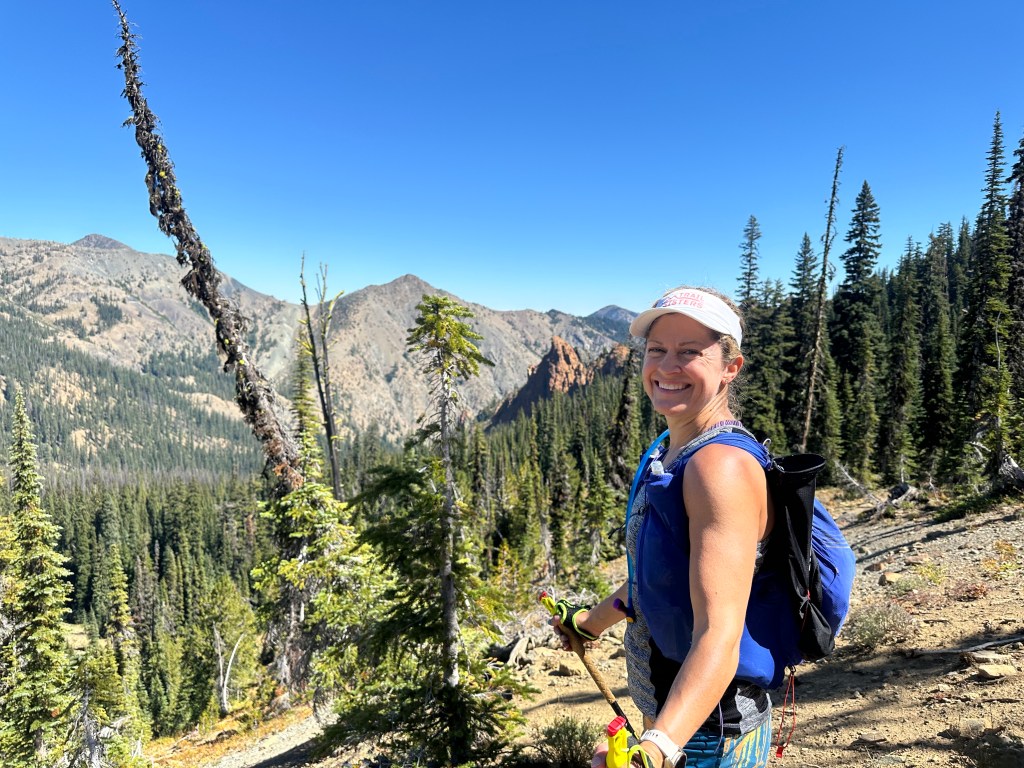
On Saturday, September 21 at 5 am, 48 racers set out, a few competing against the field, most against the course or ourselves. Race day weather was perfect for me—a bit cool but not frigid to begin. We started out with a comfortable grind up almost 7 miles of forest service road, smooth and not very steep. As we climbed, the sun began to light up mountains near and afar—moments like these reinforce why I train to spend time on the trails.
Soon after the first aid station, I connected with another racer, David Seidman. I recognized him from Tiger Claw, where I’d volunteered and he’d run this year. We had about 9 miles together, cruising single track and chatting about running, family, reading, work… With so few starters, I’d expected to spend most of the day alone, so it was a pleasant surprise to find social time early in the day. We split after the second aid station, David moving ahead, saying I’d probably catch him later, while I fueled and moved some things around in my pack.
I have to take a moment here to call out the volunteers for this race. Aid stations and volunteers make (or break) a trail race, but Teanaway attracts special crews, folks who come out and camp all weekend to support racers (it’s an out-and-back course, so we hit each aid station twice). Two aid stations are remote and accessible only by 4WD jeep trails, and yet they were as well stocked as you’d hope for any 100 miler—chairs, fire pits, hot food, so many volunteers.
Soon I was onto trails that I’d covered with Jenny earlier in the month. It was comforting to be on familiar terrain, even when I knew there’d be some grinding. I had a moment of wondering whether I was moving as well as I thought when runners started catching me on a technical downhill, but then I realized they were the 50K runners who had started a few hours after the 100, taking a shorter route to this section of the course. I managed to stay on course and avoid the missing turns that others hadn’t. The temps were warming up pleasantly. Hitting Lake Ann, I knew I’d be seeing my crew in about 90 minutes.
I felt good coming into the Iron Peak aid station (~ mi 28), the first crew access. I’d been fueling well, and the technical trails weren’t wearing me down much yet. My crew restocked my pack, and I grabbed my poles, knowing I was heading into another long climb and a bit of technical descending. I got to see my crew again in just 2-1/2 hours (~35 mi in) and was also delighted to find my friend Christie had come out and linked up with them. After just a few minutes, I was heading out for the next climb.
The ascents were becoming more grindy, but it wasn’t unexpected—nearly 12 hours and 11,000 ft of vert down. It was also getting a little smokey, dispersed from a prescribed burn in the area, which with the dust from trails and dry air, started settling into my respiratory system ever so mildly. I knew the first part of the descent on the other side of the peak was technical, so I was hoping to catch it before dark. But I also made sure to take in the views along the way. As the light faded, I started meeting more racers who were already on their return trip.
When darkness falls
It was fully dark when I reached the next aid station, about 45 miles in, and was able to pick up my first pacer, Jenny. This is where a switch flipped. I’d been coming into aid stations on the front end of my projections. Starting with Jenny, though, I was just in a mode of walking quickly up the slightest incline, even as this was some of the least technical trail I’d been on since the road section in the morning. This is consistently the point when my mind/body shifts in endurance events, when I’ve been been moving for 14 or 15 hours and now in the dark and cooler temps. Whether it’s a matter of mind or body or training, it just becomes challenging to move at more than a shuffle. Eventually though, Jenny and I reached the turnaround point, retrieved my piece of caution tape from the bear canister (the token to prove I’d done the full route out), and shuffled our way back to crew.
It was getting close to midnight, and I took the longer break we’d planned. I laid down in our car, elevated my legs, and closed my eyes for a few minutes. I knew I was unlikely to sleep (and I didn’t), but the short rest put just a little more life into my body. I got myself together with the help of my crew and headed out into the night with my second pacer, Lauren. We had 17 miles ahead of us, reversing those two descents and climbs I’d done as daylight faded. There was an option for the crew to connect with us at the midway point, but I’d recommended and the crew agreed that, given the late hour, it was better for the crew to head back to the AirBnB and get some rest.
Lauren, after asking my preference, provided a stream of factoids, updates, and other chatter through the night. They would ask/nudge me to run a few steps when the trail flattened out or push a little bit on an easier uphill section, and I found myself shifting from walk to shuffle of my own volition too. The stream crossings were cautious, avoiding wet feet, but steady. We weren’t moving fast but were making consistent progress.
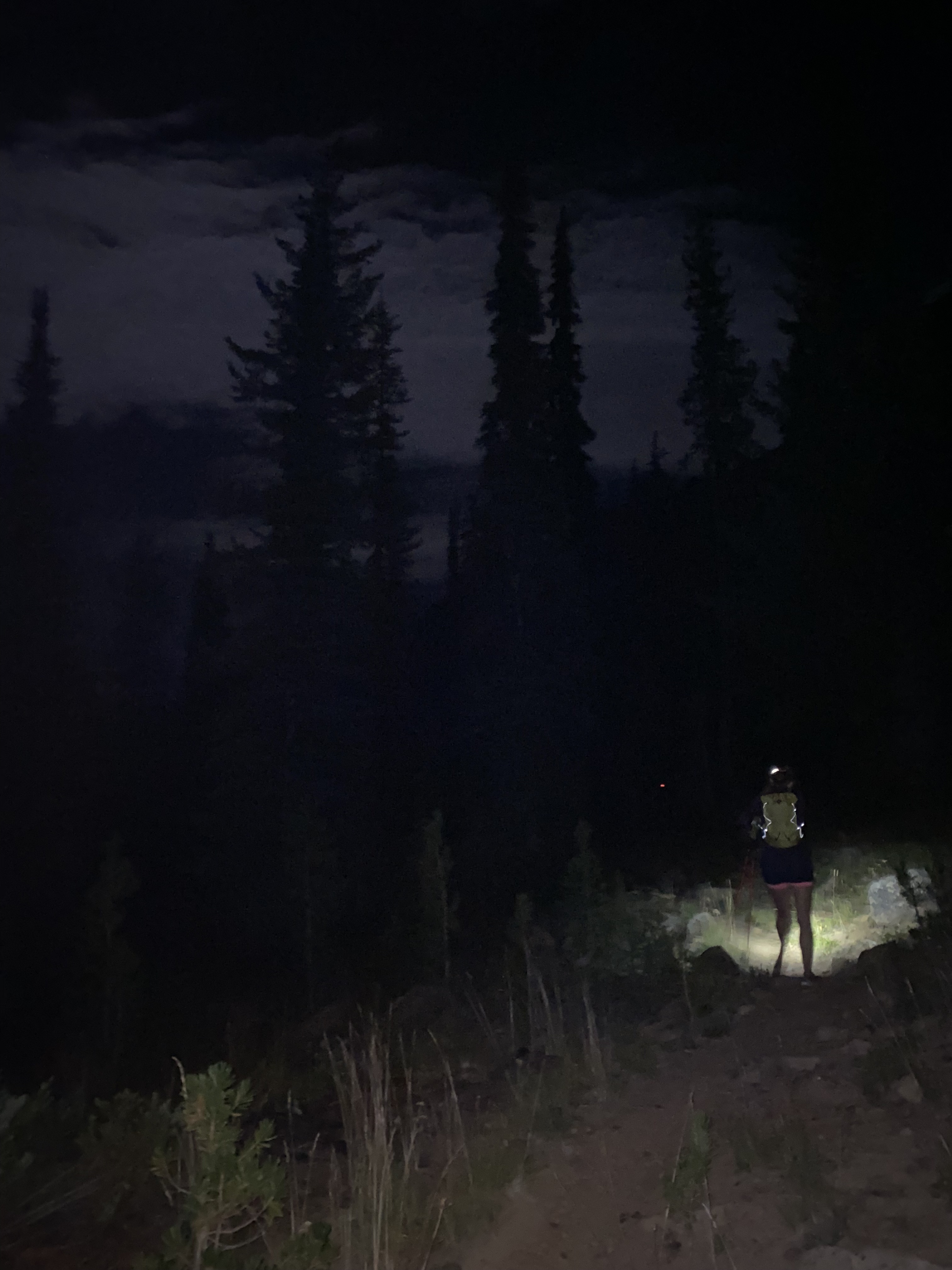
Despite the exhaustion, there is something special and magical about wandering along trails in the middle of the night. I am forced into a frame of presence, the world mostly shrinking to the sphere our headlamps illuminate. My attention focuses to a few steps ahead. Yet I wonder what the local critters think of this unusual behavior, the strange humans making a rare pilgrimage through their home, paying no heed to the hour and lighting up the night. I marvel at the felt sense of mounds of earth looming above, even when you can barely make them out by star and moon light. I am struck by both the quiet and the noise of nighttime in the wilderness.
And then in the dark hours of the morning, the trail glowed—strands of lights marking the way into the Beverly Turnpike aid station, where we were greeted with music, more light, and warm food. It’s just the sort of hype you need as you approach 24 hours of motion. As delightful as the environment and volunteers were, though, this was no time to dally.
Lauren and I had been surprised by the relative warmth of the night, but as we set out on the next climb, we were beset by cooler temps as the trail followed the curve of a large creek below. I had known this might be a challenging point of the race—darkest night, sleep deprivation, no real meal since dinner Friday night, 100 km in my legs, a penetrating chill. As we continued to ascend, encountering more rocky terrain, my eyelids were inviting me to slumber. But I knew this was no time to sleep, and besides…
The sun always rises
It’s another part of the magic of night running. You push through the darkest hours—sometimes figuratively in terms of body, mind, and emotion, as well as literally for your surroundings. Then just as it faded away many hours before, the light crescendos. Silhouettes of the landscape emerge. Soon the scene takes on more texture, the contours of the terra becoming more pronounced. Next, the colors of the world beyond the circle of light cast by the headlamp materialize. Day has returned—you knew it would, it must, but its arrival reassures the heart and awakens the body.
Lauren and I reached the saddle of the climb just about the official time of sunrise. I took a few moments, sitting on a small boulder, to stow my headlamp and jacket and take on some fuel. Then it was time for the 3.5 mile descent to the crew—and proof positive that, while this might be one of the toughest 100 milers in America, it might well be one of the most beautiful as well.
Sunrise hues set a stunning backdrop for Tahoma, mother of waters (aka Mt Rainier). Not a bad way to start a day.
As we’d descended, Lauren and I worked out the game plan for the pit stop. I would be coming into Iron Peak aid station a little after the mid-point of my time estimates. But maybe if I didn’t spend too much time in the aid station and could keep moving consistently, I’d still make the goal of finishing in daylight. We arrived to the cheers of the crew. I changed my shirt and fueled—with food and coffee—while my crew sorted out my pack. Just over 10 minutes later, I was walking up the forest road at a fast clip with Freddy, who would be with me for the final 28(ish) miles. There would be no more crew access or bail out points. It was just us, the trail, and a couple of remote aid stations until the end.
Miles to go before I sleep
The uplift of sunrise, downhill motion, caffeine, and crew was unfortunately short lived. As the trail pitched upward, my legs were lead, and tempering perceived effort (i.e., managing respiratory and heart rates) at anything more than a plod became more challenging. Reaching the pass, descending into Lake Ann Basin didn’t seem much faster. It started with steep gravel covered trail, and this brought the first fall (not bad for 75+ miles). However, it was just an easy drop onto my ass. The biggest issue was getting my legs back under me again, given the fatigue and steepness of the trail. Slowly but surely, though, I skidded and tripped and shuffled my way through to the next aid station.
This is when some impatience began to set in. I wasn’t moving as quickly downhill—or uphill or flat, for that matter—as I wanted. In retrospect, this was also approaching the point of my longest run ever in terms of time (my first 100 took just under 31 hours). We hit the jeep trails again, and I found them annoying, rocky and rutted ups and downs, sometimes having to wait for multiple 4WD vehicles to clear a corner or drop before moving on.
Freddy, though, was a steady, quiet presence, saying little but keeping up moving. He spotted a red furry friend in the woods, an adorable, curious little friend—think a fox-colored ferret. It took several moments for my sleep deprived brain to dredge up its name, marten, but it felt like a small victory.
Yet, as we continued up the jeep trails, I began to sink into a pool of trepidation. I was beginning to worry about the time, whether we would make to the finish line before the 40-hour cutoff. I could imagine getting through the course but without the official finish and buckle, the disappointment I’d feel even as I knew my crew and friends would celebrate the accomplishment. I needed to manage my headspace and put on some music to try to shift my spirits, with only modest success.
I hadn’t fully lost my sense of connection though. I recognized and told Freddy, “This is the bullshit section.” when we reached it. Just before the Gallagher Head Lake aid station, we caught up to David again, my running companion from Saturday morning. He was limping a bit, and as I approached, I observed, “Ah, a fellow excavator in the pain cave.” It also seemed like fate that we should meet again at the aid station where we’d parted ways. Only this time I was the one to get out ahead.
Do the work
Leaving the aid station, we had about 16 miles to the finish and 7 hours to get it done. On a normal day and a normal course, that seems imminently doable. But I knew we had 3 climbs and descents over the next 9 miles, the shortest but also steepest ones of the race that could (and did) easily slow me down to 30+ min/miles at points. I wouldn’t say that I was running scared, but I was certainly determined. I didn’t want to put all the time and effort I had poured into this day, my training leading up to it, the support of my friends and partner and come up short of the finish.
At some point on one of the climbs, Freddy asked if this was the hardest race I’d done, harder than my first 100. Absolutely, hands down. I was deep in the pain cave, not a place I frequent even though I do a lot of hard things. But I kept reminding myself that I had chosen to this, precisely because it was so hard and would likely challenge me in ways I hadn’t been before. This was the work I had chosen to lay beneath my feet, and now it was time to get it done.
Despite these being the shortest climbs of the race, they seemed to go on forever. The descents were so steep and loose that it felt as though we weren’t moving much faster down than up, though objectively we were. Starting down one, I took a slide right down flat onto my back, again luckily nothing painful or injurious. I just got back up, brushed myself off, and got moving again.
Finally, after a seeming eternity, we could make out the ridge at the top of the final climb. A kindly older man was at the intersection. He spoke warmly, telling us there was just a short bit of uphill remaining and pointing the way home. Looking north, ominous clouds were rolling into distant peaks, and a bracing wind hit us. It seemed unlikely that the storm would reach us, but still it spurred a slight sense of urgency to get the heck off the mountain.
The single track went on longer than I recalled, but at last, Freddy and I saw the forest road ahead, with the water drop and gels. Now it was just a 6.5 to 7 mi non-technical descent on wide, relatively smooth packed dirt and 3 hours remaining on the clock. A wave of relief surged over me. It might have taken longer than I’d hoped, but now I was confident that I would be getting that buckle.
Wring out a little more
“Everything hurts, and I feel nothing,” I told Freddy as I jogged at his rapid hike pace. But as I let gravity pull me downhill, I realized I was moving fast enough to break 39 hours if I kept it up. It was a silly, arbitrary goal, but I wanted something to keep me motivated. I shared this with Freddy, adding a little accountability for myself. With about 4 miles to go, I declared, “We could be done with this fucking thing in about an hour.”
In the final miles, a few folks caught and passed us. This poked my competitive edge a bit. I hate getting passed in the final miles of a race. I tried to pick up my pace. I soon found I was giving it all I had, and that just wasn’t enough to stay ahead. But ultimately, it didn’t matter, because this was a contest with the course and my head, and that was a contest I was on track to win.
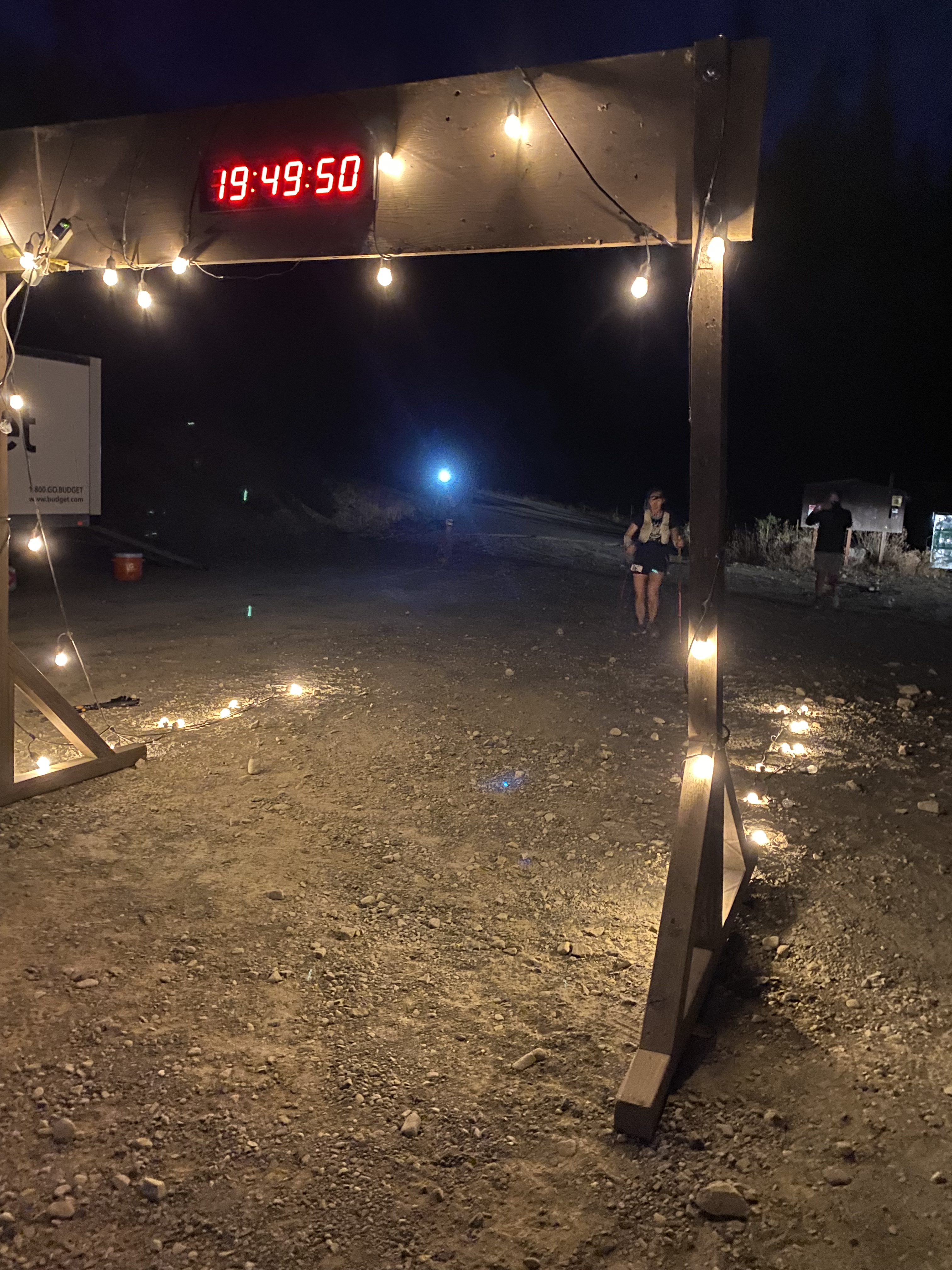
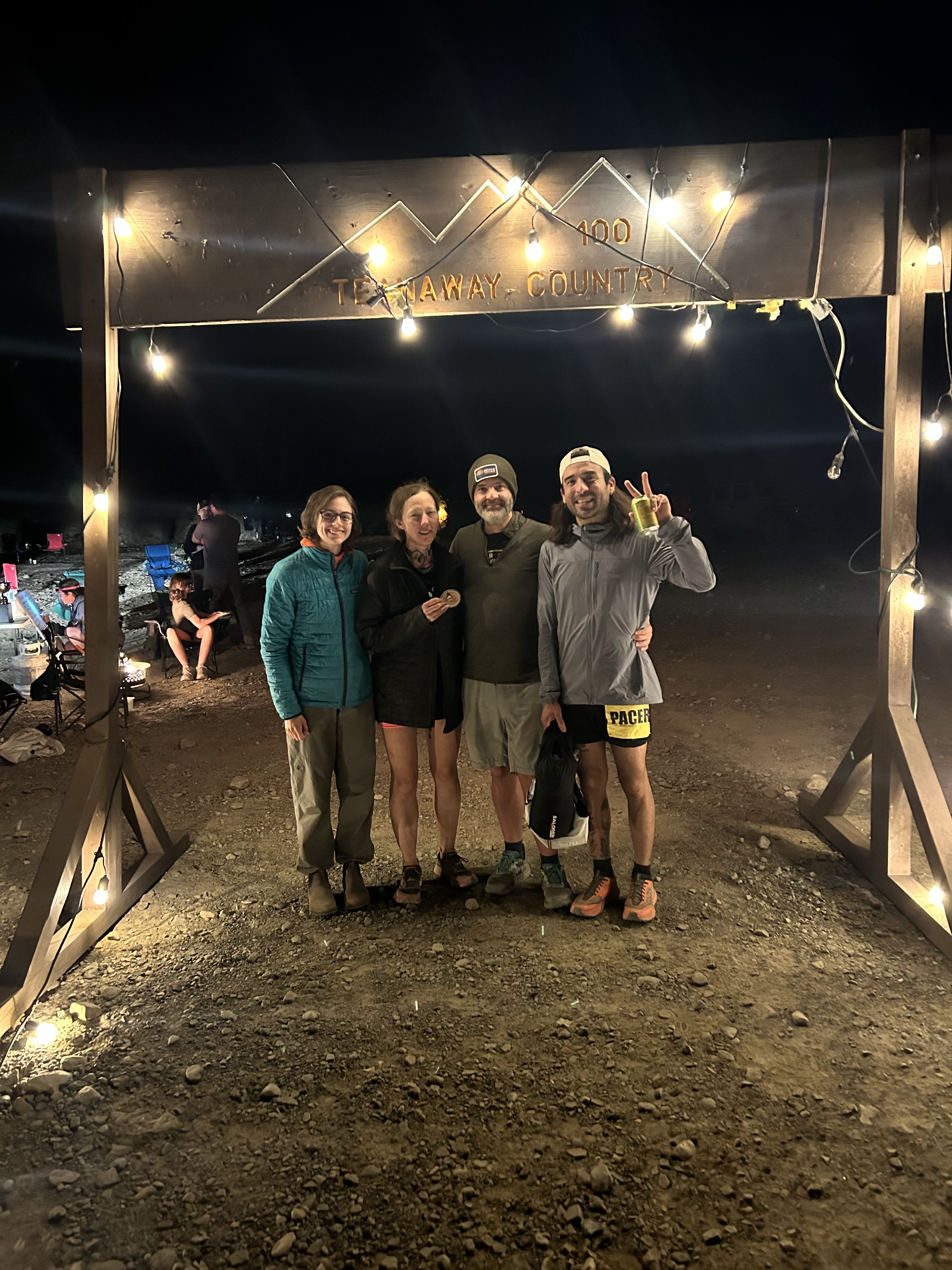
On Sunday night, 38 hours and 50 minutes after starting the Teanaway Country 100, I crossed the finish line.
The funny thing about 100 mile races is that life doesn’t look any different after I’m done and back in the day-to-day. This is true of even the hardest. Yet at the same time, it’s an experience that chisels and molds me in ways I can’t quite articulate or understand. I did this incredibly hard and beautiful and special thing, and I got to share it with some amazing people, friends and strangers alike.
And I took home this pretty cool buckle in the end.






 Boundary Conditions